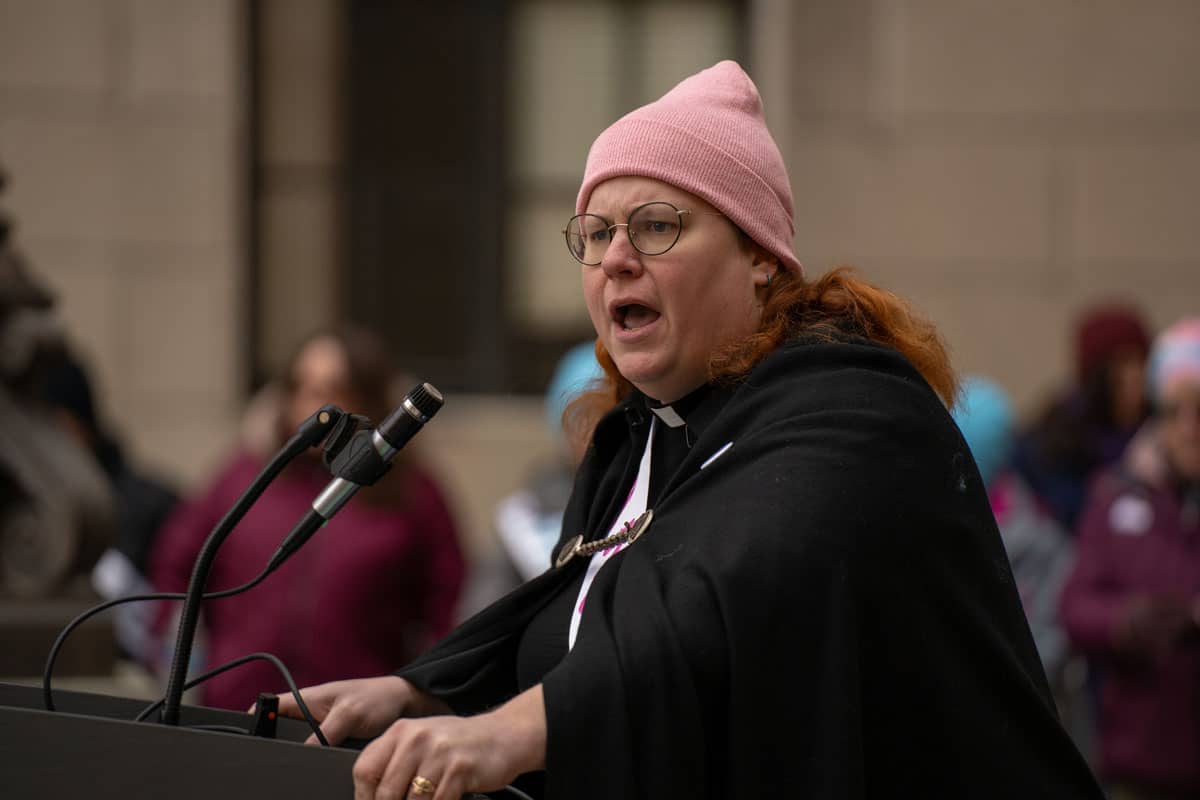
For an Episcopal priest who is also transgender, speaking at a rally in front of the New Jersey State House in Trenton was not a departure from her ministry but an extension of it.
Drawing on Christian theology rather than political rhetoric, the Rev. Abigail King told lawmakers and supporters at the January 5th rally that gender-affirming care is not at odds with faith – rather, that God calls us to live truthfully.
“I have seen in my life and my ministry the benefits of gender-affirming care – that it relieves suffering, yes, but also that it allows people to flourish, to become who they are, to follow the truth that’s been written on their hearts,” she told the gathering.
King spoke as New Jersey lawmakers weighed Bill A4656, introduced in June 2024, which would codify existing protections for gender-affirming care established in a 2023 executive order by Governor Phil Murphy.
Time is short: the current session of the New Jersey Legislature ends on January 12. If the bill is not passed by then, it will need to be reintroduced in the new session. While it has broad support among New Jersey lawmakers, it is unclear whether it is supported by Governor-elect Mikie Sherrill, who takes office on January 20.
King spoke with Nina Nicholson, diocesan Director of Communications, about the relationship between Christian faith and transgender advocacy. A condensed version of their conversation follows.
Q: This is the first time you’ve spoken at a rally to advocate for trans issues. Why now?
I was intentionally quiet about it for a while, and I’ve gotten a little louder. It’s really become clear to me that being quiet about it and just being like, well, this is just me, isn’t possible. We live in a world where my ability to exist is a political debate, and that’s exhausting – but it’s worse when the debate is settled against you. I think it’s time to be a little louder and a little more pointed.
Q: Why is this legislation so urgent?
Across the country, gender-affirming care is being targeted through bans, subpoenas, and attempts to cut off insurance coverage. These efforts aren’t stopping with minors. They’re starting there because it’s easier, but the goal is very clearly to eliminate this care for everyone. Shield laws matter because some states are already trying to subpoena records and intimidate providers and patients.
Q: You grounded your remarks in faith rather than policy. Why was that important?
Because for many queer people, interpretations of scripture have been used against them, but Jesus taught us to tell good teachers from bad by the fruit they bear. The path of affirming people and empowering them to become who they are, and protecting them from those who persecute them and drive them down – that bears good fruit. It bears a bounty of joy.
Q: You’ve said you’re “done tolerating tolerance and accepting acceptance.” What do you mean by that?
If God allows for us, and God made us how we are, then God wants us to be who we are. I’ve known a number of trans people who have struggled to get out of the closet, myself included. I’ve seen a lot of them stay out of fear, out of a certainty that they wouldn’t transition well, out of certainty that they’d be rejected. And many of them, luckily, I’ve seen transition. The difference in what it’s like to live as yourself is – it’s huge. And if God is love, then God wants that. If you have to redefine love so that it requires people to live in pain, that’s not love. That’s the same definition abusers use.
So, yeah, I don’t think trans people are merely allowed or permitted. I think we’re commanded by God to be who we are. It’s the only way that we can bring all our gifts.
Q: As a trans priest, how you see your ministry?
I see part of my ministry right now to just be visible and out there, showing that we’re just people. We’re butchers and bakers and candlestick makers, and also Episcopal priests. A bunch of people at the rally hadn’t seen a trans priest before.
One of the big problems that the transgender community has in their quest for liberation, in contrast to the cis, homosexual and bisexual communities, is that gay people are something between 10 to 20% of the population. Everyone’s got a gay cousin. Everyone’s got a gay co-worker. There are enough gay people that everyone knows someone. Trans people are somewhere between a half [a percent] to 3% of the population. Not everyone has a trans cousin, not everyone has a trans co-worker, and so it’s easier to tell stories about us.
Q: This current legislation may not pass in time. What can allies do going forward?
Call your representatives and tell them protecting transgender people is important to you. There’s always this urge [for politicians] to throw people under the bus, but that doesn’t slow the bus down – the bus runs on bodies. Make sure your representatives know you don’t want them to throw us under the bus.
Photo: Maria Keough, Courtesy WadeIn-NJ.